
- Blog
- Mobile network coverage

Mobile network coverage in Morocco: how good are Maroc Telecom, Orange and Inwi?
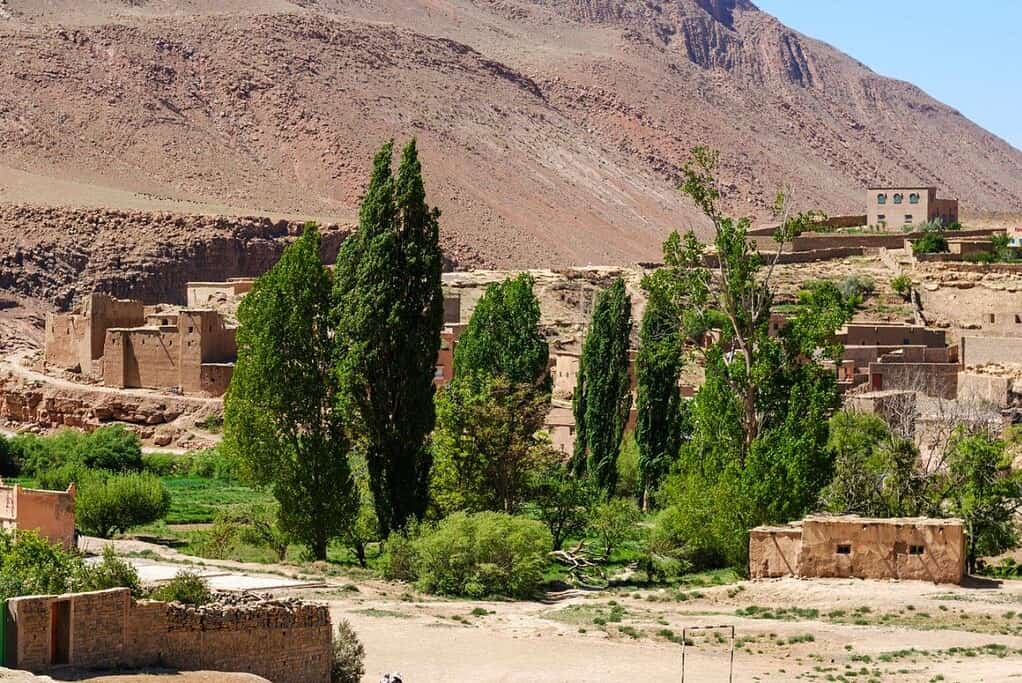
Three operators cover Morocco: Maroc Telecom, Orange Maroc and Inwi. All three advertise national coverage. In practice, your signal depends far less on the brand than on where you are standing — and that changes everything once a trip combines Marrakech, the Atlas and the desert.
Key points
- Maroc Telecom has the widest reach outside cities; Orange and Inwi match it in urban areas.
- What decides your signal is where you are, not which brand you pick: cities and main roads are well covered, mountain valleys are directional, dunes have nothing.
- No single operator covers an itinerary that mixes city, mountains and desert.
Which operator should you choose in Morocco: Maroc Telecom, Orange or Inwi?
Maroc Telecom runs the widest network in the country, Orange Maroc dominates the cities, and Inwi charges the lowest prices. Here is what each one actually covers.
Maroc Telecom (IAM) is Morocco’s incumbent operator. It owns the widest network in the country, particularly in rural areas, in the mountains and across the south. When a single bar appears in the middle of nowhere, it usually belongs to Maroc Telecom.
Orange Maroc is the Moroccan subsidiary of the Orange group. It covers Casablanca, Rabat, Marrakech, Tangier and Agadir densely, along with the tourist corridors, but loses signal faster than Maroc Telecom once you leave the main roads.
Inwi is Morocco’s third mobile operator. It often posts the lowest prices and performs well in urban areas, but it has the most uneven rural coverage of the three.
The three operators at a glance
| Operator | Cities and main roads | Mountains and countryside | Price |
|---|---|---|---|
| Maroc Telecom | Very good | The widest reach | Highest |
| Orange Maroc | Very good | Drops off away from roads | Mid-range |
| Inwi | Very good | The most uneven | Often the cheapest |
Why does coverage depend on where you are rather than which operator?
Geography decides your signal in Morocco, not the operator. The country holds three very different coverage situations: cities have signal everywhere, mountains have it intermittently, dunes have none.
Cities and main roads. Casablanca, Rabat, Marrakech, Tangier, Agadir and Fes carry all three networks on 4G. 5G in Morocco is rolling out progressively across those urban centres. In these cities, your choice of operator changes almost nothing.
Valleys and mountains. The Ourika valley, Imlil, Aït Bouguemez, the Todra gorges and the Tizi n’Tichka road receive a directional signal: you have coverage on a ridge and lose everything two bends further down. Maroc Telecom pulls clearly ahead on this terrain.
Desert and off-road tracks. Merzouga, Erg Chigaga and Zagora have signal around the villages and the established camps. It disappears as soon as you move into the dunes, and no operator is an exception to that rule.
Three traps travellers fall into
Three mistakes come up again and again: buying a SIM card without checking how it is registered, relying on the Wi-Fi where you are staying, and choosing an operator for a single location.
1. Buying a local SIM card without a second thought. The local SIM card looks like the obvious answer and causes the most trouble: Morocco requires identity registration, street vendors remain unreliable, and some cards arrive already registered in a stranger’s name. We cover the subject in SIM cards in Morocco.
2. Relying on hotel and riad Wi-Fi. In the medina, many riads share a single ADSL line across fifteen rooms. That “included” Wi-Fi is enough to check email; it supports neither a video call nor uploading a day’s photos.
3. Optimising for one location only. A typical week in Morocco crosses three different coverage zones. A plan tuned for Marrakech will not serve you in the Atlas.
Is Morocco included in EU roaming?
Morocco is not part of the roam-like-at-home area included in European plans. A European traveller therefore pays out-of-bundle roaming rates, among the highest they will encounter, and receives the bill a month later. We cover the subject, along with the settings to change on your phone before departure, in how to avoid high roaming charges in Morocco.
What actually solves it for a trip
For a stay of a few days to a few weeks, a portable Wi-Fi router removes the operator question entirely. You are no longer looking for the best network: you no longer have to choose.
A portable Wi-Fi router rented locally connects to whichever mobile network is available and shares it with all your devices — phones, tablets, laptop — for the whole family or group, with no SIM card to handle and no plan to change. This is the service we operate: see the best pocket WiFi in Morocco and, for an itinerary on the road, traveling by camper van in Morocco.
If the idea is new to you, start with what is a pocket WiFi. We weigh it against a digital SIM in pocket WiFi vs eSIM in Morocco, and we explain the rental process, the timing and the return in how to rent a WiFi router in Morocco. The rental terms cover the rates and the handover, and a pocket Wi-Fi rental in Morocco can be arranged before you land.
Frequently asked questions
Which mobile operator is best in Morocco?
Is there 4G everywhere in Morocco?
Is 5G available?
Do I need a Moroccan SIM card to get online?
Will my phone work in Morocco?