
- Blog
- Signal in the desert

Is there phone signal in the Moroccan desert? What works, and what stops working
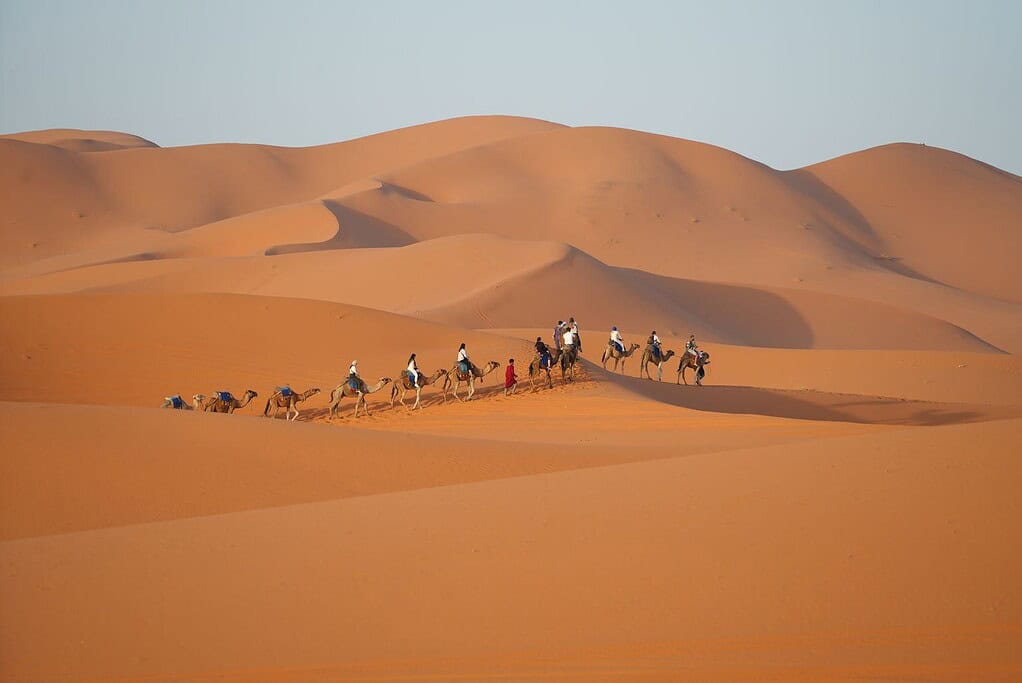
Merzouga and Zagora raise the same question before every departure: will we be reachable? The honest answer is neither yes nor no. Signal in the Moroccan desert is a matter of three hundred metres — 4G in the village, nothing once you enter the dunes.
Key points
- Signal follows people, not terrain: gateway villages and established camps have coverage, the dunes and the tracks between them do not.
- The Atlas is trickier than the Sahara — coverage there is directional, present on a pass and gone five minutes down the valley.
- The Wi-Fi advertised by desert camps is usually one phone sharing its connection, and it stops with the generator.
Is there phone signal in Merzouga and out on the dunes?
Moroccan operators build masts where residents, roads and businesses are, so coverage in the south follows settlement rather than terrain. The gateway villages and the established camps have signal; the erg and the tracks between two points do not.
- The desert gateway villages have signal. Merzouga, Hassilabied and Khamlia sit on the Erg Chebbi side; Zagora and M’Hamid El Ghizlane on the Erg Chigaga side. All of them receive 4G, sometimes excellent 4G.
- Established camps often have signal. Permanent bivouacs that host guests year-round generally stand within reach of a mast, or equip themselves for it.
- The dunes do not. Signal drops as soon as the 4×4 leaves the track and enters the erg. At Erg Chigaga, expect tens of kilometres with nothing at all.
- The tracks between two points are worse. The Foum Zguid to M’Hamid route and the loop via Ouzina form the country’s genuine dead zones.
Why do you lose signal in the Atlas more often than in the desert?
Travellers lose signal more often in the Atlas mountains than in the Sahara, because mountain coverage is directional rather than absent. In the desert the network stops cleanly and you prepare for it; in the mountains it appears on a pass, vanishes in the valley five minutes later, and returns at the next bend.
The stretches concerned run through the Ourika valley beyond Setti Fatma, the climb to Imlil and Toubkal, the Tizi n’Tichka in cloudy weather, the floor of the Todra and Dades gorges, and Aït Bouguemez.
A trek or a full-day hike has to plan around this: nobody can reach you for several hours, and you cannot warn anyone that you are running late.
What does not work, and why
Three fallbacks disappoint travellers in the south: the Wi-Fi advertised by camps, a local SIM card bought at the airport, and European roaming. None of them creates coverage where the network is absent.
Camp Wi-Fi. Many bivouacs advertise Wi-Fi. In practice the manager shares a hotspot from their own phone, and switches it off at night along with the generator.
A local SIM bought at the airport. The card gives you access to the same operator’s network as everyone else, so it changes nothing where that operator has no coverage. We cover buying local cards in SIM cards in Morocco.
European roaming. Roaming works exactly where the Moroccan network works, no more and no less, and costs considerably more. See how to avoid high roaming charges in Morocco.
What genuinely improves things
No device creates coverage where there is none, but two decisions change the experience: carrying hardware that receives better than a phone, and preparing the before and the after rather than the during.
1. A device that receives better than a phone. A portable Wi-Fi router carries a dedicated antenna and better sensitivity than a smartphone in your pocket. At the edge of coverage — precisely what valleys and the surroundings of camps give you — that difference is real. The router also shares one connection with the whole group, instead of everyone hunting for their own bar of signal. See the best pocket WiFi in Morocco.
2. Prepare the before and after, not the during. Download offline maps, share your itinerary with someone at home, queue your messages, and sync photos once you are back in coverage. A night under canvas with no signal makes a fine experience when you plan for it.
If you travel independently over several days, traveling by camper van in Morocco covers the same question on the road.
Where you have signal, in short
The table below sums up what receives a mobile network in southern Morocco and what does not, from the desert gateway villages to the floor of the gorges.
| Location | Mobile network |
|---|---|
| Merzouga, Hassilabied, Khamlia | Yes, 4G generally good |
| Zagora, M’Hamid El Ghizlane | Yes |
| Permanent Erg Chebbi camps | Usually |
| Heart of Erg Chigaga | No |
| Tracks between oases | No |
| Ouarzazate, Tinghir, Er-Rachidia | Yes, very good |
| Floor of the Todra and Dades gorges | Patchy |
| Imlil, upper Toubkal valley | Patchy, directional |
A pocket Wi-Fi rental in Morocco is booked before leaving for the dunes, not on site.
Frequently asked questions
Is there 4G in Merzouga?
Do desert camps have Wi-Fi?
How do I stay reachable during a night in the desert?
Is the network better in the Atlas than in the desert?