
- Blog
- Camper van in Morocco
Traveling by Camper Van in Morocco: Paperwork, Routes and Staying Connected
Morocco is one of the easiest camper van destinations from Europe: a short ferry from Spain, free formalities at the border and campsites at most stops. Here is what to know before you go, checked in October 2026: vehicle paperwork, the crossing, routes, where to sleep, driving, and how to keep internet on the road.
The essentials
- A foreign car or camper van can stay in Morocco for up to 6 months per calendar year under free temporary admission.
- Check that Morocco (MA) is not crossed out on your Green Card; otherwise you need border insurance.
- The shortest crossings leave from Tarifa (about 1 hour) and Algeciras (1.5 to 2 hours) to Tangier.
- Diesel passed €1.47 a litre on 1 October 2026; fill up before long stretches in the south.
- 4G covers most inhabited roads but not everything: download offline maps for the desert and the mountains.
Pocket WiFi in Marrakech
Maroc Telecom 4G router: €4.90 a day (2-day minimum), up to 10 devices, delivered and collected free of charge at your accommodation in Marrakech, 9 am to 6 pm.
Book onlineCard payment in euros.
In this article
- Before you go: camper van paperwork
- Crossing: ferries between Spain and Morocco
- Classic camper van routes
- Where to sleep: campsites, guarded car parks and wild camping
- Driving a camper van in Morocco
- Internet on the road: what to expect
- Rent A Phone: when a rented router makes sense in a camper van
- Checklist before hitting the road
- Camper van in Morocco: frequently asked questions
Before you go: camper van paperwork
Temporary admission: on arrival, customs registers your vehicle under temporary admission. It is free and done at the border. A car or camper van can stay up to 6 months per calendar year, in one or several visits; once that total is reached, it must wait until the following year (AutoActu.ma, October 2025). The vehicle must leave Morocco with you; overstaying means paying import duties.
Documents to show: valid passport, original vehicle registration certificate, driving licence, proof of insurance covering Morocco. If the vehicle is not in your name (borrowed, leased, rented), carry a power of attorney or the written authorisation of the owner or finance company.
Insurance: a Green Card is valid for the countries that are not crossed out in its territorial validity box. If MA is crossed out, you must buy border insurance in Morocco (BCMA). Ask your insurer before leaving: some cover Morocco on request, others do not.
Crossing: ferries between Spain and Morocco
Most camper van travellers cross the Strait of Gibraltar. The main routes in 2026, according to Ferryhopper:
- Tarifa – Tanger Ville: about 1 hour, with Baleària and Africa Morocco Link. You arrive in the city itself.
- Algeciras – Tanger Med: 1.5 to 2 hours, the busiest route, with several operators (Baleària, Trasmediterránea, FRS, Naviera Armas, Africa Morocco Link). Tanger Med is outside the city, directly on the motorway.
- Motril – Tanger Med: about 8 hours (Baleària).
- Almería – Nador: 7 to 11 hours, handy to start in eastern Morocco.
- Barcelona – Tanger Med: 30 to 35 hours (GNV), to avoid driving across Spain.
Fares depend on vehicle length and height: declare your camper’s exact dimensions (bike rack included) when booking. In summer, crossings are very busy with Moroccans living abroad returning home, so book early and expect waiting time at the port.
Classic camper van routes
A first trip often follows a loop through the north, the desert and the Atlas, then the Atlantic coast:
- The north: Tangier, blue-washed Chefchaouen, then Fes and Meknes for the imperial cities.
- To the desert: across the Middle Atlas to Merzouga and the Erg Chebbi dunes, then the Todra and Dades gorges and the Draa valley.
- The Atlas: Ouarzazate, then the Tizi n’Tichka pass (about 2,260 m) to Marrakech. It is a winding mountain road: drive in daylight, take your time, and check the weather in winter.
- The coast: Essaouira, Agadir, Mirleft, before heading back north on the motorway.
Allow plenty of time: distances look short on the map, but mountain roads, village crossings and police checks slow a heavy vehicle down. Fewer stops and more time at each is the better plan.
Where to sleep: campsites, guarded car parks and wild camping
Campsites are the easiest choice: water, electricity, waste disposal and often a guard. Near Marrakech, two campsites well known to camper van travellers are in Ouahat Sidi Brahim, on the outskirts: Le Relais de Marrakech (pool, restaurant, allocated pitches described as tight in 2026 reviews) and Camping Le Ferdaous (shaded, with a pool; transport to town can be booked on site), according to their Park4Night and Campercontact listings. Check recent reviews and opening before you go.
Apps such as Park4Night, iOverlander and Campercontact list campsites, aires and car parks with recent comments from other travellers. They are far more useful online (today’s reviews, photos, warnings), but download areas in advance for places without signal.
Wild camping: we found no clear official text that allows or bans it everywhere. In practice it is tolerated in some places and refused in others, notably on parts of the coast and in towns; police or gendarmerie may ask you to move to a campsite or guarded car park. Stay discreet, keep away from houses, do not put out furniture and leave no trace. If in doubt, ask a car park guard or the local gendarmerie.
Driving a camper van in Morocco
- Speed limits: 60 km/h in towns, 100 km/h on roads, 120 km/h on motorways unless signed otherwise (Wikipedia, based on the Moroccan highway code).
- Police checks: police and gendarmerie regularly stop vehicles at town entrances. Slow down and keep your papers handy.
- Fuel: after the increase of 30 September 2026, diesel rose to about €1.48 a litre and petrol to about €1.44 in the Casablanca area (Le360). Prices vary slightly between cities. In the south and the mountains, fuel stations are further apart: fill up before every long stretch.
- Motorways are tolled; carry cash.
- At night: avoid driving, especially off the motorway (poorly lit pedestrians, mopeds, carts and animals).
Internet on the road: what to expect
On a camper van trip, internet is used for everything: route, weather, campsite reviews, calls home and sometimes work. Here is what the figures say, and their limits.
- Maroc Telecom reports 4G coverage of 99% of the population (2025 annual report). Population, not territory: towns, villages and main roads are well covered; tracks, deep gorges and desert far from villages much less so.
- According to Opensignal (April 2026, data from January to March 2026), Maroc Telecom users had a mobile signal (3G, 4G or 5G) 94.6% of the time, and the country’s fastest typical download speed, 27.5 Mbps.
To see where you really get signal in the south, read our article on phone signal in the Moroccan desert and our comparison of mobile coverage across the three operators.
Ways to stay connected:
- A local SIM or eSIM in your phone, bought with your passport: the cheapest option for one or two travellers.
- Buying a 4G router locally, worth it for a long stay: inwi sells a MiFi with Vacay wifi passes at about €9.20 for 7 days, about €18.50 for 14 days or about €27.50 for 30 days (inwi, October 2026); Orange sells the Wifi D’jib 4G+ for about €18.50. We compare these in renting vs buying a pocket Wi-Fi in Morocco.
- Renting a router for a shorter trip, with no shop visit (see below).
Either way, download offline maps (Google Maps, Maps.me, Organic Maps) and your Park4Night areas before leaving the towns.
Rent A Phone: when a rented router makes sense in a camper van
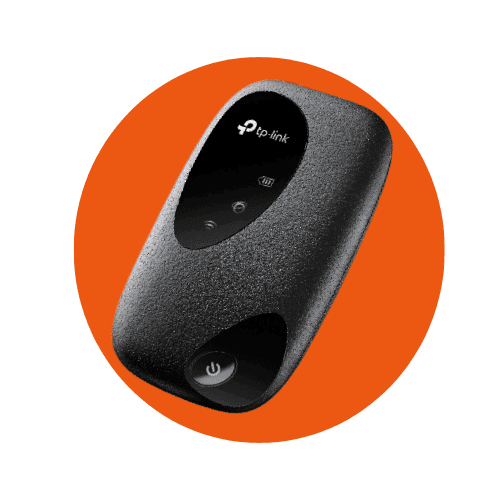
Rent A Phone rents a TP-Link 4G (Cat 4) pocket Wi-Fi router on the Maroc Telecom network, with unlimited data, for €4.90 per day (2-day minimum). Up to 10 devices can connect, so a family camper does not need a SIM for everyone. The battery lasts up to 8 hours; the router charges over USB, so from the vehicle’s socket while you drive. A power bank is available for €1.90 per day.
One important limit: we deliver and collect in Marrakech only (hotel, riad, Airbnb or wherever you’re staying). The router works wherever Maroc Telecom’s 4G reaches, but you receive and return it in Marrakech. It suits you if you rent your camper van in Marrakech, or if your trip starts and ends at Marrakech airport. If you arrive by ferry in Tangier with your own vehicle and do not pass through Marrakech at the start and end, a local SIM or a router bought locally will be simpler.
On speed: up to 150 Mbps in theory, typically a few tens of Mbps in town (often 20 to 50 Mbps), less in the mountains. It is 4G, not 5G. Payment is online, by card, in euros; a €50 deposit is held as a card pre-authorisation, not charged, and released on return. Customer service answers 7 days a week, 9am to 6pm. To book: booking page.
Checklist before hitting the road
- Valid passport, original registration certificate, licence, power of attorney if the vehicle is not yours.
- Green Card with Morocco not crossed out, or budget for border insurance.
- Ferry booked with the vehicle’s exact dimensions.
- Offline maps and Park4Night or iOverlander areas downloaded.
- Internet sorted: SIM, eSIM, bought or rented router.
- Cash in dirhams for tolls, campsites and small purchases.
- Full tank before southern and mountain stretches, and a water reserve.
- Exit date noted: 6 months maximum per calendar year for the vehicle.
Camper van in Morocco: frequently asked questions
How long can I stay in Morocco with my camper van?
A foreign camper van can stay up to 6 months per calendar year under temporary admission, in one or several visits. Once that total is reached, it cannot re-enter under this regime until the following year. The procedure is free and done at the border.
What documents do I need to drive a camper van into Morocco?
A valid passport, the original registration certificate, your driving licence and insurance covering Morocco. If the vehicle is not in your name, you need a power of attorney or written authorisation from the owner or finance company.
Is wild camping allowed in Morocco?
There is no clear, uniform rule: wild camping is tolerated in some places and refused in others, notably on parts of the coast and in towns. Police may ask you to move to a campsite or guarded car park; if in doubt, ask locally.
Where can I stay with a camper van in Marrakech?
Camper van travellers mostly use campsites on the outskirts, such as Le Relais de Marrakech and Camping Le Ferdaous in Ouahat Sidi Brahim. Check recent reviews on Park4Night or Campercontact before you go.
Is there mobile signal on Moroccan roads?
Yes on main roads, in towns and villages: Maroc Telecom reports 4G coverage of 99% of the population. Tracks, gorges and desert far from villages have dead zones, so download offline maps.
Can I rent a Wi-Fi router for a camper van road trip in Morocco?
Yes. Rent A Phone rents an unlimited 4G router for €4.90 per day, for up to 10 devices, delivered and collected free in Marrakech only. It works well if your trip starts and ends in Marrakech; otherwise a local SIM or a locally bought router is simpler.