- Blog
- Online on arrival

Getting online the moment you land in Morocco: what actually works at the airport

You land in Marrakech or Casablanca and the first thing you look for is a signal: call the driver, find the riad’s address, tell someone you have arrived. Four options are open to you, and they are not equal at the precise moment you step off the plane.
The essentials
- Airport Wi-Fi stops at the terminal door — and outside is exactly where you need it.
- An eSIM is downloaded: you need a connection to install it, so activate it before you leave home.
- Morocco is not part of the roaming zone included in European mobile plans.
- A pocket router simply switches on: €4.90 a day, nothing to configure, up to 10 devices.
Airport Wi-Fi stops at the terminal door
An airport wireless network gets you out of trouble: a message to say you have landed, a booking to check, sometimes a map to download. It usually asks you to register, it is shared by hundreds of passengers at once, and its quality swings from one hour to the next.
Above all, it does not follow you. From the car park, from the taxi, from the first alley of the medina, you have nothing. And that is precisely where the connection matters: following the route on a map, finding the entrance of a riad hidden behind an anonymous door, calling your host because the street is pedestrian and the taxi goes no further.
Buying a local SIM on arrival: budget the time
It is the most common reflex, and the most expensive in holiday time. You have to find the shop, show an ID document, make sense of plans presented in Arabic or approximate French, wait for activation, then handle top-ups during the stay.
With several travellers the bill repeats itself: one card per phone, one activation per person, one top-up per person. A family of four ends up with four lines to watch instead of one connection to share.
The eSIM: the activation trap
An eSIM is not bought like a card, it is downloaded. To install the profile on your phone you already need a connection — the airport one, with all its uncertainties. So the rule is simple: if you go for an eSIM, install it before you leave, at home, on your own Wi-Fi.
Two checks are worth making beforehand. Not every device supports eSIM, older or entry-level models in particular. And some carriers lock the eSIM, which means the handset has to be unlocked first.
Roaming: Morocco is not in your European plan
This is the classic nasty surprise on the bill you find when you get home. Morocco is not part of the roaming zone included in European mobile plans: unless you have taken a specific option with your carrier, every megabyte used there is charged at roaming rates.
Leaving mobile data on “just for the map” for a fortnight is enough to turn a taxi ride into an unexpected line on your statement.
The pocket router: switch it on and it works
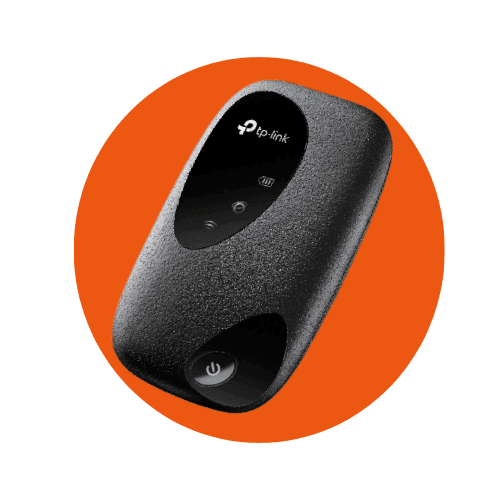
A portable Wi-Fi router picks up the local mobile network and rebroadcasts it as Wi-Fi around it. It arrives ready to use: the network name and password are printed on the device, there is no app to install and no SIM to insert. You turn it on, everyone connects.
At Rent A Phone the rental is €4.90 per day, for a minimum of 2 days, with a €50 deposit refunded when you hand the device back. The connection is unlimited, up to 300 Mbps on 4G, shared by 10 devices, with 8 hours of battery — enough for a full day of sightseeing and a recharge overnight. A power bank can be added for €1.90 a day.
Which airport, which logistics?
The distance between the airport and your accommodation changes what you need to plan for. Marrakech Menara is 6 km from the centre: you are in the medina within minutes. Casablanca Mohammed V, Royal Air Maroc’s hub, is about 25 km from central Casablanca — and 250 km from Marrakech, which leaves plenty of time to need a map on the way.
Agadir Al Massira is some twenty kilometres from the city and the beaches, Tangier Ibn Battouta 15 km from the centre, and Fes Saïss about fifteen kilometres south of the city. The longer the transfer, the sooner the question “do I have a signal right now?” comes up.
In Marrakech the router is collected on the spot or delivered to your hotel: it is in your hands when you need it, not three days later.
Frequently asked questions
Is there free Wi-Fi in Moroccan airports?
Terminals generally offer a wireless network, often after registering. It is fine for a message, but it is shared, uneven, and it stops when you leave the terminal: it does not replace a connection that follows you into town.
Can I activate an eSIM right after landing?
Only if you already have a connection to download the profile, typically the airport Wi-Fi. The safest route is to install it before you travel, having first checked that your phone supports eSIM and is not carrier-locked.
Does my European plan work in Morocco?
Morocco is not part of the roaming zone included in European plans. Without a specific option taken with your carrier, your usage is billed at roaming rates.
How much does a pocket Wi-Fi router cost and where do I collect it?
€4.90 per day, two days minimum, with a €50 deposit refunded when you return the device. Pick-up in Marrakech or delivery to your hotel, ready to use: nothing to install and no SIM to insert.