- Blog
- WiFi in Morocco
WiFi in Morocco: hotels, riads, cafés, airports and trains

Yes, there is WiFi in Morocco, and you will find it almost everywhere travellers sleep and eat in the cities: hotels, riads, rented flats and many cafés. Quality, however, varies enormously from one place to the next: Ookla measured median WiFi download speeds ranging from just over 10 Mbps to 72 Mbps across ten five-star hotels in the country. And that WiFi stops at the door: in the street, on a day trip or in the desert, only the mobile network goes with you.
The essentials
- Hotels, riads and rentals almost all offer free WiFi, but speed depends on the line, the number of guests and the walls: ask for a speed test before booking if you need to work.
- Median fixed internet speed in Morocco: 56.69 Mbps; on mobile: 68.41 Mbps (Ookla, September 2026 edition).
- Airports and trains: we could not confirm free WiFi on the official ONDA and ONCF websites on 23 October 2026. Plan for a mobile connection.
- On public WiFi, check the exact network name, avoid banking and prefer your own mobile data (US cybersecurity agency CISA’s advice on fake hotspots).
- To stay online everywhere: eSIM, local SIM or pocket WiFi. For a group staying in Marrakech, the Rent A Phone router (4.90 € a day) is delivered free to your accommodation.
Pocket WiFi in Marrakech
Maroc Telecom 4G router: €4.90 a day (2-day minimum), up to 10 devices, delivered and collected free of charge at your accommodation in Marrakech, 9 am to 6 pm.
Book onlineCard payment in euros.
In this article
- Is there WiFi in Morocco? The numbers
- WiFi in hotels and riads
- Cafés, restaurants and medinas
- Airports and trains: do not rely on free WiFi
- Desert, Atlas Mountains and countryside
- WiFi in Morocco, place by place
- Public WiFi: the precautions to take
- Alternatives to WiFi: SIM, eSIM or pocket WiFi
- Frequently asked questions about WiFi in Morocco
Is there WiFi in Morocco? The numbers
Morocco is well connected for a visitor. Ookla’s Speedtest Global Index, September 2026 edition, gives a median of 56.69 Mbps download and 52.63 Mbps upload for fixed broadband, the kind that feeds hotel and holiday-rental WiFi. That is enough for a video call, as long as the line is not shared by too many people.
Two figures call for caution. First, the gap between cities: at the end of 2024 Ookla measured 36.55 Mbps in Rabat and 35.57 Mbps in Casablanca, but 28.96 Mbps in Marrakech, 23.64 Mbps in Agadir and 20.57 Mbps in Tangier. Second, fibre is not everywhere: according to ANRT figures quoted by Ookla, the country had about 2.6 million fixed connections in September 2024, 990,000 of them fibre, for roughly 8 million households. Some of the homes rented to travellers therefore run on a 4G box or an ADSL line, which is slower.
The mobile network is often faster than the WiFi: a median of 68.41 Mbps on phones in September 2026 according to Ookla, 5G included. For everyday 4G use, Opensignal measured a typical download speed of 27.5 Mbps on Maroc Telecom in the first quarter of 2026. See also our page on mobile network coverage in Morocco.
WiFi in hotels and riads
Almost every place to stay in the tourist cities advertises free WiFi, usually with no time limit. “Free WiFi” says nothing about speed, though. Ookla studied ten of the country’s best-known five-star hotels over eighteen months (August 2023 to February 2025): the best exceeded 50 Mbps at the median, the weakest sat at around 10 to 19 Mbps. Ookla even noted that some five-star hotels in Casablanca and Rabat, the cities with the best fibre, had slower WiFi than hotels in Agadir or Marrakech. Star ratings are not enough to judge: the hotel’s own equipment is what counts.
The riad problem
A riad is a traditional house built around a courtyard, with thick earth or brick walls and rooms spread over several floors. WiFi signals struggle through those walls. If the router sits at reception, a top-floor room or one at the back may get a weak signal, sometimes none. Well-equipped riads put a repeater on every floor; others share a single line between all the rooms, which slows everyone down in the evening, when every guest uploads their photos.
Flats and villas
In a flat or villa, the connection depends on the owner’s subscription: fibre, ADSL or a 4G box, common outside the big cities. Fine for messages, sometimes tight for a day of video calls: our guide to working remotely from Morocco covers this in detail.
- Ask what kind of line it is fibre, ADSL or a 4G box: the answer tells you more than “free WiFi”.
- Ask for a speed-test screenshot taken in the room, with the upload speed: that is what keeps a video call alive.
- Ask where the WiFi is in a riad, choose a room close to the router or a repeater.
- Read recent reviews and search them for “wifi”: guests are quick to flag a connection that does not reach the rooms.
- Have a mobile plan B if you need to work, an eSIM or a pocket router makes you independent of the hotel line.
Cafés, restaurants and medinas
In tourist districts and city centres, many cafés and restaurants offer WiFi to customers. Ask the waiter for the password; it is sometimes printed on the receipt. Handy for a break, less so for work: the connection is shared and slows down at busy times. For a proper working day, see our pick of coworking spaces in Marrakech.
In the lanes of the medinas, do not count on open WiFi: that is exactly where you need a map or have to call your riad, and that is where it is missing. Only the mobile network follows you.
Airports and trains: do not rely on free WiFi
You will often read that Moroccan airports and stations have free WiFi. We tried to check this at the source on 23 October 2026: the website of ONDA, which runs the airports, could not be reached that day, and the only mentions we found were press articles from 2015 and 2016. The ONCF’s official ticketing site (oncf-voyages.ma) does not mention WiFi on board its trains, Al Boraq included. So we are not claiming it exists: check on the spot, and do not build your arrival around it.
An airport network, where there is one, ends at the terminal exit anyway. Our page on getting online the moment you land in Morocco compares what actually works on arrival. On the train, rely on mobile data, which can drop in places between cities.
Desert, Atlas Mountains and countryside
Away from the cities, WiFi becomes rare and depends on the mobile network. In desert camps, the advertised “WiFi” is often a shared 4G connection, which only works if the camp has signal. In Atlas guesthouses, there is a connection in the villages, rarely beyond.
Prepare those legs of the trip: offline maps, your route shared with someone at home. Our article is there phone signal in the Moroccan desert? goes through what works, place by place.
WiFi in Morocco, place by place
| Where | WiFi | What limits it | Plan B |
|---|---|---|---|
| City hotel | Almost always, free | Number of guests, hotel equipment | Mobile network, 4G or 5G |
| Riad in the medina | Almost always, free | Thick walls, one line for every room | Room near the router, mobile data |
| Flat, villa | Usually | Type of line (fibre, ADSL, 4G box) | Ask for a speed test first |
| Café, restaurant | Often, for customers | Shared connection, peak hours | Coworking space for work |
| Street, medina, day trip | No | No reliable open network | Only mobile data follows you |
| Airport, train | Not confirmed | Official sources silent or unreachable | eSIM installed before you fly, SIM or router |
Rent A Phone summary based on Ookla data (2025-2026) and the ONDA and ONCF websites checked on 23 October 2026.
The weak point of hotel WiFi is almost always upload speed, the one used to send: backing up your photos or holding a video call in the evening, when the whole hotel is online, is the hardest test.
Public WiFi: the precautions to take
Watch out
An open network named after a hotel or café is not necessarily theirs: anyone can create a network called “Riad_Free_WiFi”. Ask the staff for the exact name and password, and never do your banking on public WiFi.
The US Cybersecurity and Infrastructure Security Agency (CISA) describes the “evil twin” attack: someone sets up a fake access point that imitates a public network with a stronger signal, and reads what victims send through it, including card numbers and passwords. Its advice: “Always confirm the name and password of a public Wi-Fi hotspot prior to use”, make sure the networks you join use at least WPA2 encryption, and turn off file sharing on public networks.
- Check the exact network name and password with the staff.
- Prefer a password-protected network to an open one.
- Turn off file sharing and automatic joining of WiFi networks.
- For banking, payments or bookings, switch to mobile data or your own router.
With a pocket router, the WiFi network is yours, protected by its own password.
Alternatives to WiFi: SIM, eSIM or pocket WiFi
Roaming on your home plan
Morocco is outside the EU’s roam-like-at-home area. Vodafone UK, for instance, puts Morocco in its “Zone D”, charged with a daily fee or a pass that depends on your plan. Check the price with your provider before you fly, and see how to avoid high roaming charges in Morocco.
A local SIM or eSIM
Maroc Telecom, Orange and inwi sell prepaid SIM cards on presentation of your passport. An Orange Marhaba plan with 7 days of unlimited data costs about 11 € (price checked on 13 October 2026). It is the cheapest option for one person, with a Moroccan number, but you buy it locally: see buying a local SIM in Morocco.
A travel eSIM
An eSIM is installed at home before you leave and works as soon as you land, with no shop and no passport, on a compatible, unlocked phone. Our pick for a solo traveller: eSIM Maroc, 24 € for 7 days (1 GB a day at full speed, then 512 kbps), price checked on 13 October 2026. How-to: eSIM in Morocco.
Rent A Phone pocket WiFi
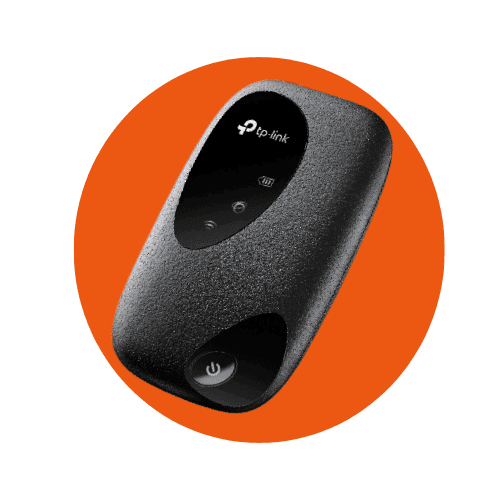
A pocket router creates your own WiFi wherever there is mobile signal. Rent A Phone rents a TP-Link 4G router on the Maroc Telecom network with unlimited data for 4.90 € per day per router (2-day minimum); up to 10 devices can connect and the battery lasts up to 8 hours. It is delivered and collected free of charge at your accommodation in Marrakech (hotel, riad, flat), between 9 am and 6 pm, and then goes with you on day trips. Payment by card in euros, a 50 € deposit held as a card authorisation only, support 7 days a week from 9 am to 6 pm. You can book your router online; what is a pocket WiFi explains how it works.
Our verdict
Your hotel or riad WiFi is fine for the evening, rarely for the rest of the day. Travelling alone with a compatible phone, install eSIM Maroc before you leave. Two or more of you, with a laptop or children, or worried about your riad’s WiFi: the Rent A Phone router delivered in Marrakech connects everyone for 4.90 € a day.
Frequently asked questions about WiFi in Morocco
Is there WiFi in Morocco?
Yes. Most hotels, riads and rentals in the cities offer free WiFi, as do many cafés and restaurants in tourist areas. Speed varies a lot from one place to another, and there is no reliable WiFi in the street, in the medina or on day trips.
Is WiFi free in riads and hotels in Morocco?
In the vast majority of cases, yes, it is included in the room rate. The real question is quality: in a riad, thick walls and a single line shared by every room can make the connection slow in some rooms. Ask for a speed test before booking if you need to work.
How good is the internet in Morocco?
Good in the cities. According to Ookla (September 2026), the median speed is 56.69 Mbps on fixed broadband and 68.41 Mbps on mobile. There are big differences between cities and between properties, and the connection weakens in the mountains and disappears in the dunes.
Is there free WiFi at Moroccan airports and on trains?
We could not confirm it on the official websites on 23 October 2026: the ONDA site was unreachable and the ONCF ticketing site does not mention WiFi on board. Do not count on it for your arrival; plan a mobile connection instead.
Is it safe to use public WiFi in Morocco?
As anywhere, public WiFi can be poorly secured or imitated by a fake hotspot. Check the network name with the staff, avoid banking, and prefer mobile data or a VPN, in line with CISA’s guidance on public networks.
Where can I rent a pocket WiFi in Morocco?
Rent A Phone rents a 4G Maroc Telecom router with unlimited data for 4.90 € a day (2-day minimum), delivered and collected free at your accommodation in Marrakech between 9 am and 6 pm. Up to 10 devices can connect, and it goes with you wherever Maroc Telecom’s 4G reaches.