- Blog
- Morocco road trip
Morocco Road Trip from Marrakech: Two Self-Drive Itineraries for 7 and 10 Days
The best 10-day Morocco itinerary from Marrakech is a loop: over the High Atlas by the Tizi n’Tichka pass, through the Dades and Todra gorges to the Merzouga dunes, and back via the Draa valley. That is about 1,120 km and 22 hours of driving. With 7 days, an Atlas-and-Atlantic loop covers about 870 km.
The essentials
- 10-day southern loop: about 1,120 km in 8 driving days, only one leg over 4 hours (Merzouga to Nkob).
- UK drivers must carry the 1968 International Driving Permit together with their licence, according to GOV.UK.
- Motorway tolls are paid by card, cash or Jawaz tag; Marrakech to Agadir costs about €7.30 for a car.
- Download offline maps before you leave: signal can drop in the gorges and the dunes.
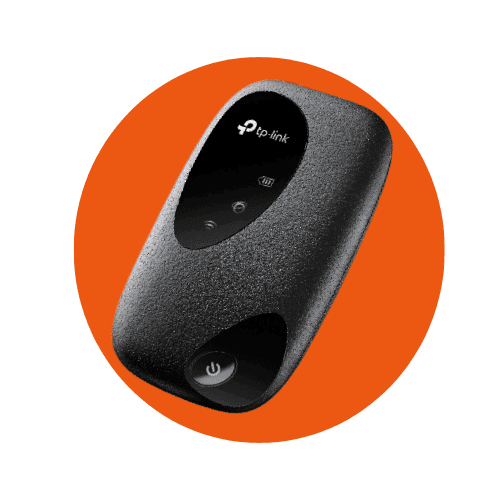
- A 4G router rented in Marrakech connects up to 10 devices in the car; it is delivered and collected at your Marrakech accommodation, so the loop must start and end there.
Pocket WiFi in Marrakech
Maroc Telecom 4G router: €4.90 a day (2-day minimum), up to 10 devices, delivered and collected free of charge at your accommodation in Marrakech, 9 am to 6 pm.
Book onlineCard payment in euros.
In this article
- Morocco road trip: 7 days or 10 days?
- Morocco itinerary 10 days from Marrakech: Atlas, gorges and desert
- Morocco road trip 7 days: the Atlas and Atlantic loop
- Driving in Morocco: licence, IDP, motorway tolls and police checks
- Offline maps: set up navigation before leaving Marrakech
- Morocco road trip internet: where signal drops
- Why put a router in the car instead of a data plan per phone
- Rent A Phone: your loop starts and ends in Marrakech
- Pre-departure checklist
- Morocco road trip: frequently asked questions
Morocco road trip: 7 days or 10 days?
A 7-day Morocco road trip forces a choice: see the Sahara and spend long days behind the wheel, or pair the Atlas with the ocean and keep drives short. Merzouga is about 550 km from Marrakech by road, roughly 10 hours without stops. A return trip in a week is possible, but you will see more tarmac than villages. With 10 days, the southern loop becomes comfortable.
Both itineraries start and finish in Marrakech. It is well served by flights from the UK and Europe, plenty of car hire desks, and it is where we deliver the router.
Driving times below are non-stop times calculated with OpenStreetMap routing (OSRM) on 3 November 2026 (tourist board times where it publishes the route) and rounded. Mountain roads, lorries and village speed bumps add time, so pad every estimate.
Morocco itinerary 10 days from Marrakech: Atlas, gorges and desert
| Day | Route | Distance | Driving (approx.) |
|---|---|---|---|
| 1 | Marrakech to Aït Benhaddou via Tizi n’Tichka | 170 km | 3 h 30 |
| 2 | Aït Benhaddou to Ouarzazate to Boumalne Dades | 146 km | 3 h |
| 3 | Dades Gorges to Tinghir and Todra Gorge | 52 km | 1 h |
| 4 | Tinghir to Merzouga | 192 km | 3 h 30 |
| 5 | Merzouga and Erg Chebbi dunes (car parked) | 0 km | 0 |
| 6 | Merzouga to Rissani, Alnif and Nkob | 227 km | 4 h 30 |
| 7 | Nkob to Agdz (Draa valley) to Ouarzazate | 135 km | 2 h 30 |
| 8 | Ouarzazate to Marrakech | 194 km | 3 h 45 |
| 9-10 | Marrakech, or a day trip to Essaouira (183 km each way) | 0 to 366 km | 0 to 5 h |
Distances and non-stop driving times from OpenStreetMap routing (OSRM), except Ouarzazate to Marrakech and Essaouira (Moroccan tourist board, visitmorocco.com), checked on 3 November 2026. Real times are longer in the mountains.
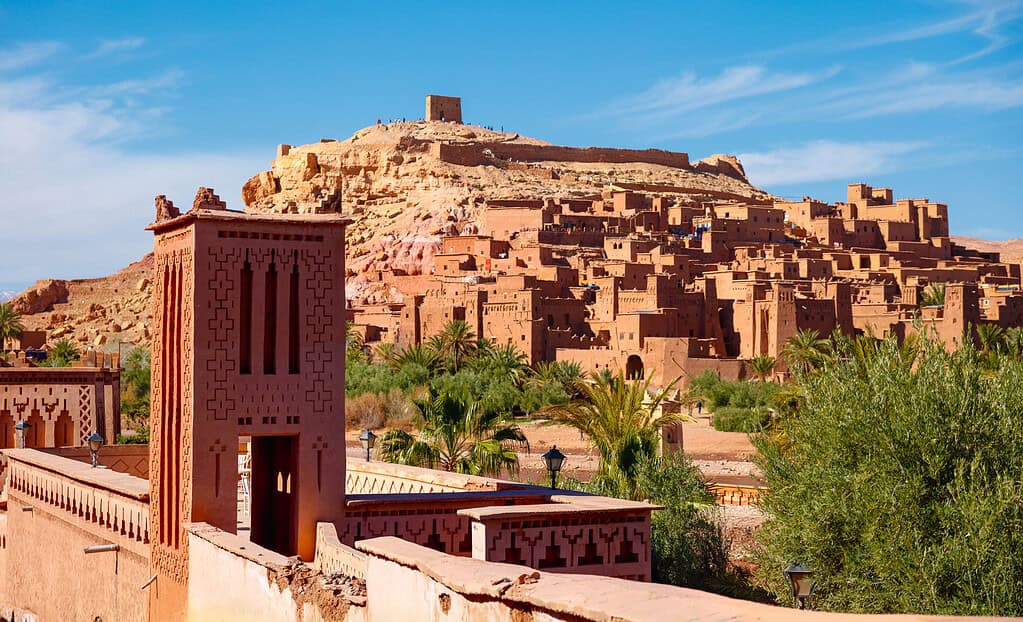
Days 1 and 2. The N9 climbs into the High Atlas to the Tizi n’Tichka pass, then drops to the fortified village of Aït Benhaddou, a UNESCO World Heritage site. Leave early so you cross the pass in daylight. Next day, Ouarzazate and the road of the kasbahs lead to Boumalne, at the mouth of the Dades Gorges.
Days 3 to 5. Both gorges are best explored on foot from the road, so day 3 is short. Then Merzouga: park in the village and spend a night in an Erg Chebbi desert camp. The sandy tracks to the camps need a suitable vehicle, not a small hire car.
Days 6 to 8. Returning via Alnif and Nkob avoids repeating the outward road and follows the Anti-Atlas to the palm groves of the Draa valley. It is the longest leg, with long empty stretches: fill up in Rissani or Erfoud, carry water and have your maps downloaded. From Ouarzazate, you cross the Atlas back to Marrakech.
More desert? Add Zagora from Agdz (about 100 km, 2 hours) for one extra day.
Morocco road trip 7 days: the Atlas and Atlantic loop
| Day | Route | Distance | Driving (approx.) |
|---|---|---|---|
| 1 | Marrakech to Aït Benhaddou | 170 km | 3 h 30 |
| 2 | Aït Benhaddou to Taroudant | 261 km | 5 h |
| 3 | Taroudant to Agadir or Taghazout | 83 km | 1 h 30 |
| 4 | Beach day around Agadir | 0 km | 0 |
| 5 | Agadir to Essaouira along the coast | 175 km | 3 h |
| 6 | Essaouira | 0 km | 0 |
| 7 | Essaouira to Marrakech | 183 km | 2 h 30 |
Distances and non-stop driving times from OpenStreetMap routing (OSRM), except Essaouira to Marrakech (Moroccan tourist board), checked on 3 November 2026.
This loop of about 870 km keeps the Atlas crossing and Aït Benhaddou, then turns west to Taroudant, a walled market town in the Souss plain. Agadir and Taghazout give you a beach day, Essaouira a seaside medina, and the drive back to Marrakech takes about 2 hr 30.
If the desert is non-negotiable in one week, drive days 1 to 5 of the southern loop to Merzouga and come back the same way via Ouarzazate: about 1,100 km in 7 days with two very long driving days and no slack for a flat tyre or a closed pass.
Driving in Morocco: licence, IDP, motorway tolls and police checks
Licence and IDP. GOV.UK (Morocco travel advice, updated 19 August 2026) says British drivers need both the 1968 International Driving Permit and their UK licence in the car, and that the IDP cannot be bought outside the UK. The French foreign ministry states more generally that a foreign licence is valid in Morocco for up to one year and strongly encourages an IDP. Since official sources word it differently, US, Canadian and Australian drivers should also get a 1968 IDP from their national motoring organisation before leaving. Hire companies add their own rules, such as a minimum age and a year of driving experience.
Tolls. All motorways are tolled, notes the Spanish foreign ministry. Autoroutes du Maroc (ADM) accepts bank cards, cash, its network card and the Jawaz electronic tag. A normal car is class 1 (two axles, under 1.30 m high at the front axle); a tall van is class 2. Our loops only use the motorway on the way out of Marrakech, but it matters if you vary the route via Agadir.
| Motorway trip (class 1) | Toll, approx. |
|---|---|
| Marrakech (Targa) to Chichaoua, towards Essaouira | €1.80 |
| Marrakech (Targa) to Amskroud | €6.80 |
| Marrakech (Targa) to Agadir | €7.30 |
ADM toll table, checked on 3 November 2026, converted to euros at about 10.86 to €1.
Police checks and rules. Gendarmerie checkpoints are common on main roads, notes the Spanish foreign ministry: slow down and keep licence, IDP and hire papers within reach. Since 16 June 2025, smart fixed speed cameras have recorded both directions of traffic (announcement by NARSA, the national road safety agency). GOV.UK warns that any alcohol in your system can mean a fine and possible imprisonment.
Watch out
Is it safe to drive in Morocco? With care, yes, but the French foreign ministry advises against driving at night, and GOV.UK warns that poor lighting makes night driving dangerous, with pedestrians and animals on the road. France also flags the mountain motorway from Marrakech to Agadir, especially the descent into Agadir. Fuel is easy to find in towns but scarcer in the countryside. After an accident, GOV.UK says to fill in a ‘constat amiable’ signed by both drivers. On the motorway, ADM assistance answers on 5050.
Offline maps: set up navigation before leaving Marrakech
Your phone’s GPS works without signal; what needs data is route calculation and loading the map. A map downloaded in advance is enough to be guided through a valley with no coverage. Do it on your hotel Wi-Fi the night before you set off.
- Google Maps tap your profile picture, choose “Offline maps”, and select an area covering the Atlas, Ouarzazate and the Tafilalet (Merzouga), plus a second one for the Souss and the coast if you drive the Atlantic loop.
- A backup app Organic Maps or Maps.me download the whole country and show small roads and tracks well.
- Your stops save every riad or kasbah as a favourite, with its phone number: in the mountains, a postal address is useless.
- Your plan send the day-by-day route to someone at home with expected arrival times.
- Entertainment download playlists, podcasts and the kids’ films before the desert legs.
Mounted on a holder, the driver’s phone navigates; the passenger looks up the next camp on another device, which means they need data too.
Morocco road trip internet: where signal drops
Maroc Telecom 4G covers cities and main roads; in the mountains and the desert, signal can drop. The operator reports 99% of the population covered by 4G (2025 universal registration document), which is people, not land area. On our loops, the overnight towns (Ouarzazate, Tinghir, Merzouga, Taroudant, Agadir, Essaouira) are well covered.
- Tizi n’Tichka: patchy on the hairpins, especially in cloud.
- Deep in the Dades and Todra gorges: partial coverage, sometimes nothing between two bends.
- Erg Chebbi dunes: Merzouga village has signal, the signal disappears once you enter the dunes.
- Merzouga to Nkob: long, thinly populated stretches where signal comes and goes.
We go place by place in phone signal in the Moroccan desert and compare the three networks in mobile network coverage in Morocco. Driving your own motorhome from Europe? See travelling by camper van in Morocco instead.
Why put a router in the car instead of a data plan per phone
With four people in a car, everyone needs internet at a different moment: the driver for navigation and traffic coming into Marrakech, the passenger to book tomorrow’s riad, the kids for their tablets. A router gives one connection to all of them, and nobody has to switch on roaming.
- Up to 10 devices at once: phones, tablets, a laptop.
- Unlimited data: evening photo backups and a video call from the kasbah do not eat into a plan.
- Battery up to 8 hours, enough for a driving day; it also charges over USB from the car.
- Road trip extras: a power bank at €1.90 a day and a car phone holder at €0.90 a day.
| Option | 7 days | 10 days |
|---|---|---|
| Router only (€4.90 a day) | €34.30 | €49 |
| Router + power bank + car holder | €53.90 | €77 |
| Cost per person for 4, router only | €8.58 | €12.25 |
Rent A Phone prices, checked on 3 November 2026. Paid by card in euros.
Pros
- One connection for the whole car
- Fixed price whatever the number of devices
- No phone to unlock or configure
Cons
- One more gadget to charge
- Handed over and collected in Marrakech only
- Same network as phones: no signal where Maroc Telecom has none
Rent A Phone: your loop starts and ends in Marrakech
For €4.90 a day (2-day minimum), Rent A Phone lends you a TP-Link 4G router with unlimited data on Maroc Telecom. We bring it free of charge to your Marrakech hotel, riad or apartment between 9 am and 6 pm, and collect it there too. We do not hand over at the airport or in any other city.
In practice, it works when your road trip starts and finishes in Marrakech: the router is waiting at your riad the evening before or the morning you leave, it travels with you on the whole loop, and we pick it up from your Marrakech accommodation at the end. If you pick up the hire car as soon as you land and head straight for the Atlas, plan one night in Marrakech first. If your trip ends in Fes, Agadir or Casablanca, the router is not the right fit: an eSIM for Morocco is simpler.
A €50 deposit is held as a card pre-authorisation, not charged, and released when the router comes back. Payment is by card in euros, support answers 7 days a week from 9 am to 6 pm, and you have a 7-day withdrawal period under our terms. To book, enter your dates and your accommodation address on the booking page; delivery details are on Marrakech pocket Wi-Fi.
Our verdict
Two or more people on a loop that starts and ends in Marrakech: the Rent A Phone router is the simplest way to connect the whole car. Travelling alone with an eSIM-compatible phone, or ending the trip elsewhere: take an eSIM Maroc plan, €24 for 7 days or €32 for 10 days, with 1 GB a day at full speed then 512 kbps (prices checked on 13 October 2026).
Pre-departure checklist
- Documents passport, licence and 1968 IDP, hire contract and insurance in the glovebox.
- Money a card for tolls and fuel, cash for villages and car park attendants.
- Maps offline areas downloaded on Wi-Fi, stops saved.
- Internet router charged, USB cable, car holder; or eSIM installed if you travel solo.
- Fuel full tank before Merzouga to Nkob and before each pass.
- Return last night booked in Marrakech, so the router is collected at your accommodation before your flight.
For the rest of your bag, see what to pack for Morocco, and for general safety is Morocco safe for tourists.
Morocco road trip: frequently asked questions
How many days do you need for a Morocco road trip?
Seven days is enough for an Atlas and Atlantic loop from Marrakech, about 870 km. To reach the Merzouga dunes and come back without driving more than about 4 hours a day, allow 10 days: the southern loop is about 1,120 km.
What is the best Morocco itinerary for 10 days from Marrakech?
Marrakech, Aït Benhaddou over the Tizi n’Tichka, Ouarzazate, the Dades and Todra gorges, Merzouga, then back via Nkob and the Draa valley to Ouarzazate and Marrakech. That is roughly 22 hours of non-stop driving spread over 8 days.
Do I need an International Driving Permit for Morocco?
GOV.UK says British drivers must carry the 1968 IDP with their UK licence. The French foreign ministry says foreign licences are valid for up to a year and strongly encourages an IDP, so drivers from other countries should carry one too.
Is it safe to drive in Morocco?
With care, yes. France and Spain advise against driving at night; GOV.UK warns about poor lighting after dark, overloaded lorries overtaking on motorways, and mountain roads in bad weather. Gendarmerie checkpoints are frequent, so keep your documents to hand.
Is there phone signal on Moroccan roads?
Maroc Telecom 4G covers cities and main roads; in the mountains and the desert, signal can drop, especially deep in the gorges and in the dunes. Download offline maps before leaving Marrakech.
Can I keep a Rent A Phone router for the whole road trip?
Yes. It works wherever Maroc Telecom 4G is available, for €4.90 a day and up to 10 devices. It is delivered and collected at your Marrakech accommodation only, between 9 am and 6 pm, so your loop needs to start and end in Marrakech.